Every business aims to grow, but not every business can clearly answer the questions: Where will growth come from, and where should resources be focused to achieve it? Segmentation, when designed effectively, does more than help businesses understand markets and customers. It also provides the foundation for strategic decisions on target markets, positioning, products, pricing, and distribution channels to achieve growth objectives.
1. Growth: A Strategic Challenge for Businesses
Growth has always been one of the top priorities for businesses. It not only drives business performance but also enables companies to invest in competitive capabilities, attract and retain talent, and develop their organizations.
Yet achieving growth is no easy task, particularly when businesses seek profitable and sustainable growth. According to a McKinsey study on more than 4,000 companies worldwide, only around 25% have been able to sustain growth over time. To achieve their growth ambitions, businesses need a well-structured and effective Growth Strategy.
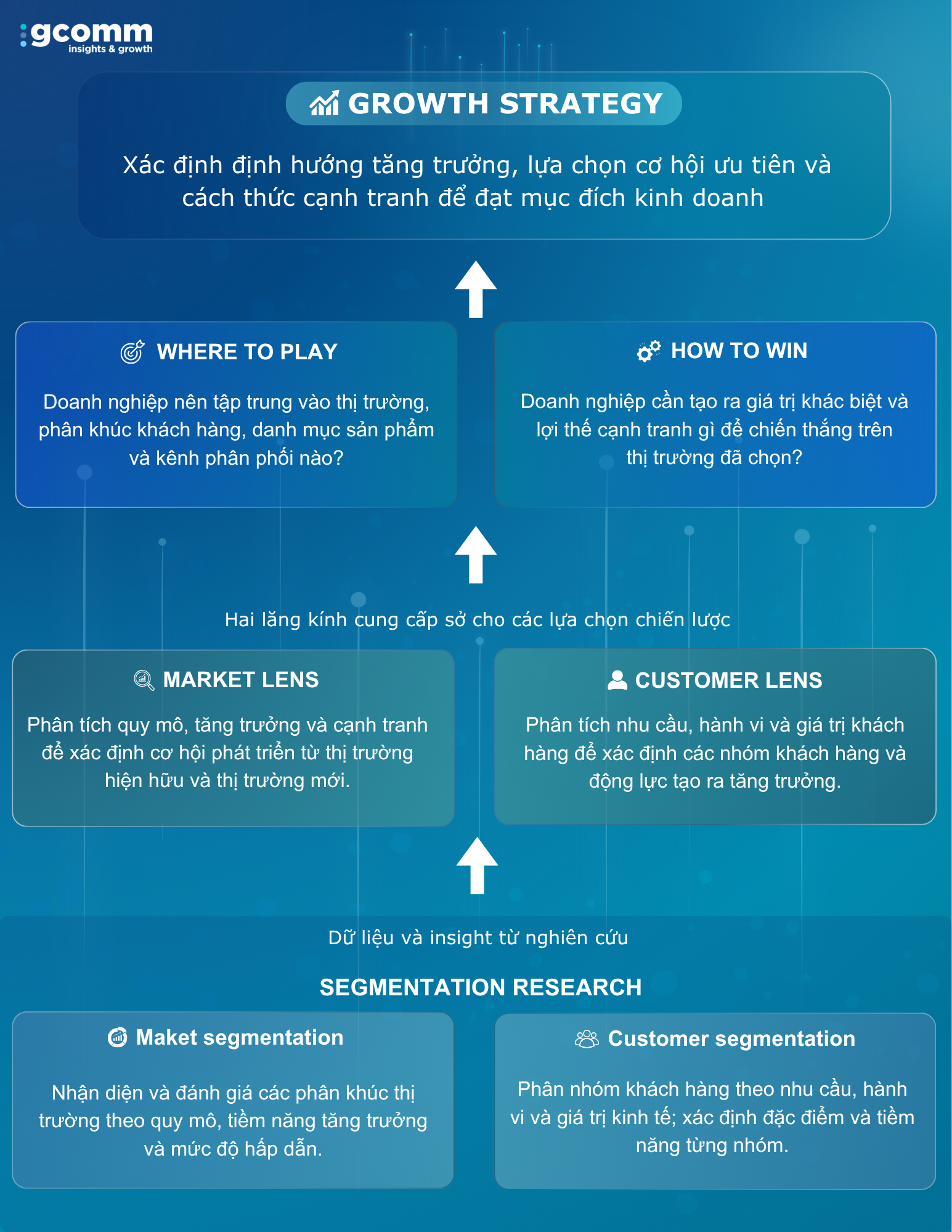
2. Growth Strategy: Choosing Where to Play and How to Win
A Growth Strategy defines how a business identifies growth opportunities, allocates resources, and makes decisions to enhance performance and competitiveness. For small and medium-sized enterprises, in particular, whose resources are often limited, a structured growth strategy helps concentrate resources on the most viable opportunities and scale in a controlled manner, rather than spreading resources too thin based on intuition.
One prominent framework is Playing to Win, developed by A.G. Lafley (former CEO of P&G), and Roger Martin. According to the authors, strategy consists of 5 interconnected choices: winning aspiration, where to play, how to win, core capabilities, and management systems. Among these, Where to Play and How to Win are the 2 central choices that shape a business’s competitive strategy.
• Where to Play: Which markets and segments will the business compete in, which customer groups will it serve, and through which channels?
• How to Win: What competitive advantage will the business create to earn customers’ preference in the markets it has chosen?
These 2 choices cannot be separated. An attractive market is not necessarily one in which a business can win. Conversely, a competitive advantage only creates real value when it addresses the needs of a specific customer group. There is no one-size-fits-all way to win; only a way to win that is suited to a specific playing field.
To answer these 2 questions, businesses need data and evidence-based analysis, rather than relying solely on intuition.
3. Diagnose Before Prescribing: Market Lens and Customer Lens
A growth strategy can go off course as early as the diagnostic stage, when businesses set targets and immediately start looking for initiatives without first analyzing where growth is coming from and where untapped growth opportunities lie.
A comprehensive diagnosis requires viewing growth through 2 complementary lenses:
• Market Lens – Where does growth lie within the market?
o The market lens helps businesses understand the size, growth rate, and competitive structure of markets in which they currently operate or may enter.
o Growth can come from the expansion of existing markets, increased market share within currently served segments, or expansion into new markets, segments, and categories.
• Customer Lens – Which customer groups can drive growth, and how?
o The customer lens focuses on the drivers of revenue and customer value.
o Businesses can grow by acquiring new customers, increasing conversion rates, driving purchase frequency, increasing the value of each purchase, or retaining existing customers. Pricing and product mix decisions can also contribute to revenue growth and profitability.
Market Lens helps businesses identify where growth opportunities exist, while Customer Lens helps them understand the customer needs and growth drivers that must be activated to realize those opportunities. Both perspectives are essential to strategic decisions made by C-level executives, as well as the execution of marketing, sales, and product.
4. Segmentation: The Analytical Foundation for Growth Decisions
Market Lens and Customer Lens can only deliver their full value when businesses are able to analyze markets and customers at a sufficient level of detail to identify meaningful differences and inform decision-making. This is precisely the role of Segmentation.
Market Segmentation: Revealing Opportunities Across the Market
McKinsey’s Granularity of Growth framework highlights that looking only at industry-wide averages can lead businesses to the wrong conclusions. An industry that is “growing” may still contain stagnant segments, while a saturated industry may have segments experiencing strong growth. Only by analyzing individual categories, segments, geographies, and channels can real opportunities become visible.
Market Segmentation, combined with granular market analysis, helps businesses identify and evaluate segments based on needs, categories, price tiers, distribution channels, geographies, etc. to assess the size, growth rate, and attractiveness of each segment. In turn, businesses can build a portfolio of growth opportunities and allocate resources based on the actual potential of each market.
Customer Segmentation: Understanding Differences to Build Competitive Advantage
While market analysis helps identify attractive opportunities, Customer Segmentation enables businesses to understand the customer groups that underpin those opportunities.
Customer Segmentation divides customers into groups that share similarities in needs, motivations, behaviors, or economic value, while exhibiting meaningful differences across groups.
However, a valuable Customer Segmentation study should go beyond identifying, naming, and describing the characteristics of each customer group. To support business decisions, each segment needs to be analyzed across 3 dimensions:
• Economic Profile – The economic value of the segment: Includes information on segment size, growth rate, profitability, customer lifetime value, etc. This profile answers the question: Is this segment worth investing in?
• Needs Profile – Needs and choice drivers: Includes the needs to be fulfilled, usage occasions, and customer choice criteria. This profile answers the question: What value must we deliver to win in this segment?
• Access Profile – The ability to identify and reach: Includes information-seeking behaviors, shopping channels, brand touchpoints, and characteristics that help identify customers belonging to each segment. This profile answers the question: How can we identify, reach, and serve this segment in practice?
In practice, the Access Profile is often one of the biggest challenges in implementing segmentation. Businesses may identify highly differentiated customer groups through research yet struggle to determine which segment a customer belongs to within their CRM system, at the point of sale, or across digital channels. As a result, segmentation findings can be difficult to translate into concrete marketing and sales actions. An effective segmentation model, therefore, must not only distinguish between customer groups but also consider how they can be identified and activated in practice.
5. The Value of Segmentation: From Strategy to Execution
Most businesses understand the importance of segmentation, but not all are able to fully unlock its value. One reason is that the role of segmentation is often narrowly defined.
Segmentation was originally designed to help businesses decide which products to develop, which channels to sell through, how to price, and how to advertise. Yet over the years, its role has been reduced almost exclusively to advertising. This makes it important to distinguish between segmentation designed to support brand image and communications, and segmentation designed to inform strategic decisions on markets, products, and customers.
When designed around specific business decisions and supported by sufficiently rich and valuable analysis, segmentation can create value across the entire journey from strategy to execution.
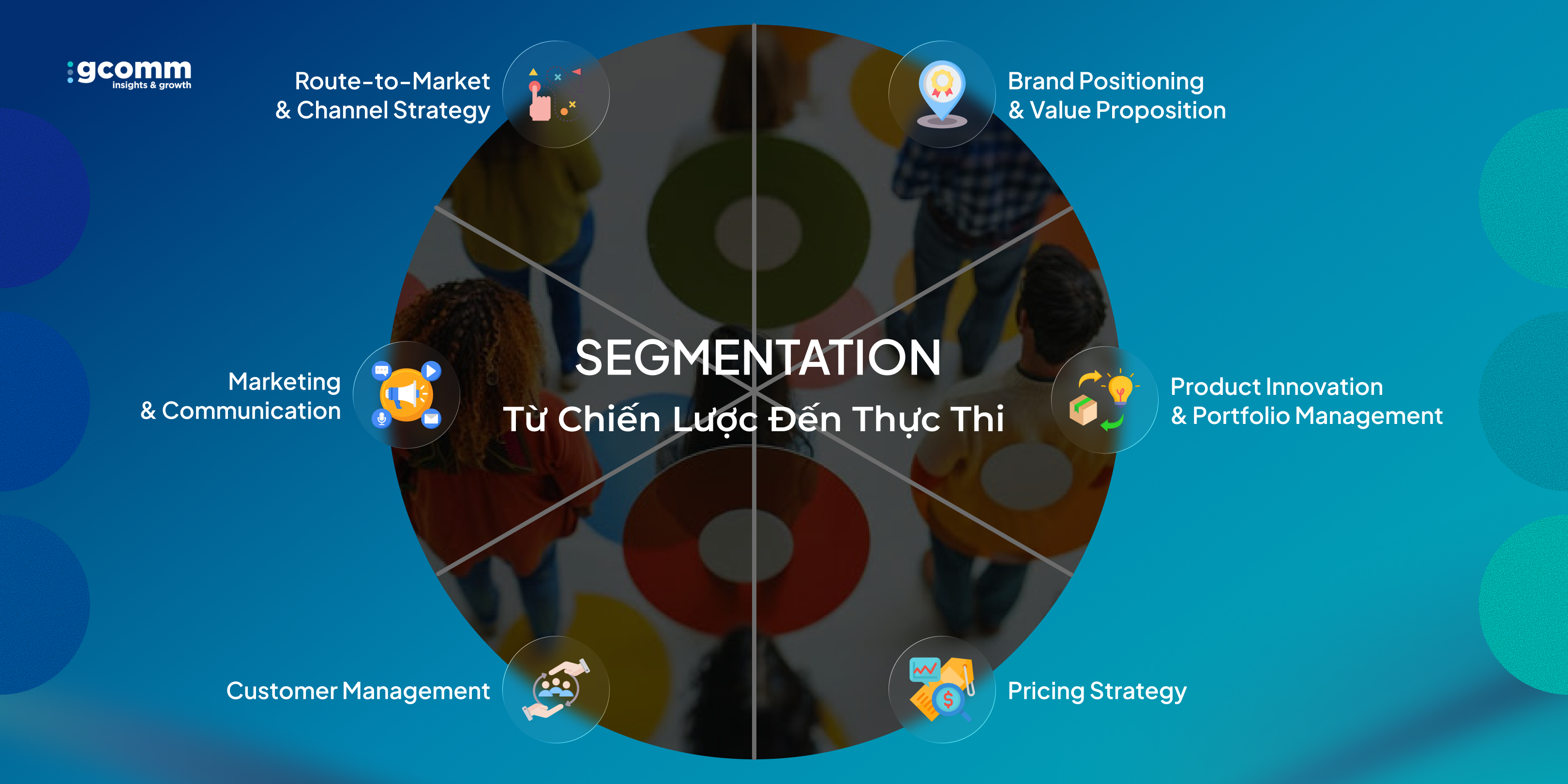 •
• Brand Positioning & Value Proposition: Customer Segmentation is an effective way to uncover unmet needs and understand the factors influencing customer choice. The Needs Profile of priority segments helps businesses determine which value propositions to focus on and develop brand positioning that is relevant and differentiated from competitors. Depending on the degree of differentiation across segments, businesses can develop distinct value propositions or tailor how they communicate value to each group.
• Product Innovation & Portfolio Management: Segmentation helps businesses identify opportunities for new product development and design a portfolio in which each product has a clear role, serving different segments without unnecessary overlap. The needs of each segment help businesses define the must-have features, nice-to-have features, and differentiating features required for products tailored to each segment.
• Pricing Strategy: Segmentation helps businesses understand differences in perceived value and price sensitivity across segments. When combined with willingness to pay research, these insights provide the basis for designing appropriate pricing structures, promotional programs, and product bundles to optimize revenue and profitability across customer groups.
• Route-to-Market & Channel Strategy: Segmentation helps businesses determine how to deliver products to the right customer groups through appropriate distribution networks and sales models. The Access Profile reveals which channels each segment typically uses for shopping and how they can be reached. Combined with data on cost-to-serve and channel effectiveness, businesses can identify priority channels to optimize distribution efficiency.
• Marketing & Communication: Segmentation helps businesses develop messages and select communication channels that align with the needs, motivations, and behaviors of different customer groups. Rather than delivering a single message to the entire market, marketing can focus on the benefits that matter most to each segment, thereby increasing the relevance and effectiveness of communication activities.
• Customer Management: Segmentation helps businesses design differentiated customer experiences that align with the expectations, behaviors, and support needs of each group. When combined with transactional and CRM data, segmentation can also help maximize value from existing customers through retention, increased purchase frequency, cross-sell, and up-sell strategies tailored to the behaviors and potential of each group.
Conclusion: Research for Growth – From Data to Growth Decisions
Sustainable growth does not begin simply by setting a higher target than the previous year. It requires businesses to understand where opportunities lie in the market, which customers generate value, and where they can win. When designed to inform strategic decisions rather than merely describe customers, segmentation becomes the bridge connecting market intelligence, customer insights, and business activities.
With extensive experience in Market Research and Business Consulting, GCOMM has developed the Research for Growth solution to help businesses identify and evaluate potential sources of growth, build practical and actionable segmentation models, and translate research findings into a foundation for concrete business decisions across branding, products, pricing, distribution channels, and communications.